
Key Takeaways
- Ditch the box for anything under 3 pounds — large mailers dodge dimensional weight charges that can double what you pay to ship a lightweight apparel order.
- Size up correctly: 14×19 and 19×24 poly mailers cover most multi-item clothing orders, while 24×24 and 24×36 sizes handle bulky bundles or return-heavy categories.
- Buying large poly mailers wholesale beats grabbing small packs from Staples or Walmart — per-unit cost drops fast once you’re ordering by the case.
- Check mil thickness before you commit to a bulk order; 2.5 mil is the sweet spot for tear resistance without paying for cushioning you don’t need.
- USPS doesn’t hand out free poly mailers the way it does with Priority flat rate boxes, so factor that cost into your shipping math up front.
- Match the mailer to the product — poly for soft goods, bubble mailers for anything with edges or slight fragility — and you’ll cut both postage and damage claims.
Here’s a number that should make every apparel seller wince: pack a light hoodie in an oversized box, and you could pay for nearly 10 pounds of “dimensional weight” you never actually shipped. That’s the trap boxes set for lightweight orders — and it’s exactly why large mailers have quietly become the default for anyone shipping clothing, textiles, or flat goods at real volume.
In practice, the shift isn’t about trend-chasing. It’s basic math. Carriers price by whichever number is bigger: actual weight or the size-based calculation. A rigid box, even a modest one, eats up cubic space fast — and that space costs money whether it’s full of product or air. A flat, flexible mailer barely registers on that scale. Ship the same 2-pound sweater in a poly mailer instead of a box, and the savings show up on every single label, every single day.
So what does that mean for sellers stocking up right now? It means knowing your sizes — 14×19, 19×24, 24×24 — and knowing when you’ve actually sized up correctly instead of just guessing. It means understanding mil thickness, tear resistance, and where to buy in bulk without overpaying at a big-box store. Realistically, getting this right is one of the fastest margin fixes an ecommerce seller can make this year.
The Real Math Behind Dimensional Weight and Why Boxes Lose
Picture a seller shipping a 2-pound hoodie in a 12x10x6 box. Sounds reasonable, right? But that box has a dimensional weight problem waiting to happen — carriers don’t just weigh the package; they measure the air inside it too. Swap that box for one of the large mailers built for apparel and textiles, and the whole equation changes.
How Carriers Calculate Dimensional Weight on Boxes vs. Flat Mailers
USPS, UPS, and FedEx all use a dim weight formula: length x width x height, divided by 139 (or 166 for some services). That 12x10x6 box comes out to 720 cubic inches — divided by 139, that’s roughly 5.2 pounds of billable weight. For a 2-pound shirt. A flat mailer, by contrast, has almost no meaningful third dimension once it’s sealed around soft goods. There’s nothing to divide, so the actual weight almost always wins.
A Side-by-Side Shipping Cost Comparison for a 2-Pound Order
Run the numbers on a typical clothing order:
- Box shipment: billed near 5 lbs due to dim weight, landing in a higher rate tier
- Poly mailer shipment: billed at actual 2 lbs, qualifying for lower first-class or flat-rate-adjacent pricing
That gap repeats on every single order, every single day. Multiply it across a few hundred shipments a month, and it’s not a rounding error — it’s real money walking out the door.
What Counts as a Large Mailer (And When You’ve Sized Up Correctly)
Most poly mailers top out around 10×13 inches. Anything bigger than that — think 14×19 and up — falls into large mailer territory, and that’s the range where sellers shipping apparel, textiles, and flat goods start seeing real savings over boxes. A large mailer isn’t just roomier packaging. It’s a different weight class entirely, one that keeps you clear of dimensional weight penalties that boxes almost guarantee once you’re past a medium order.
Common Large Poly Mailer Sizes: 14×19, 19×24, and 24×24
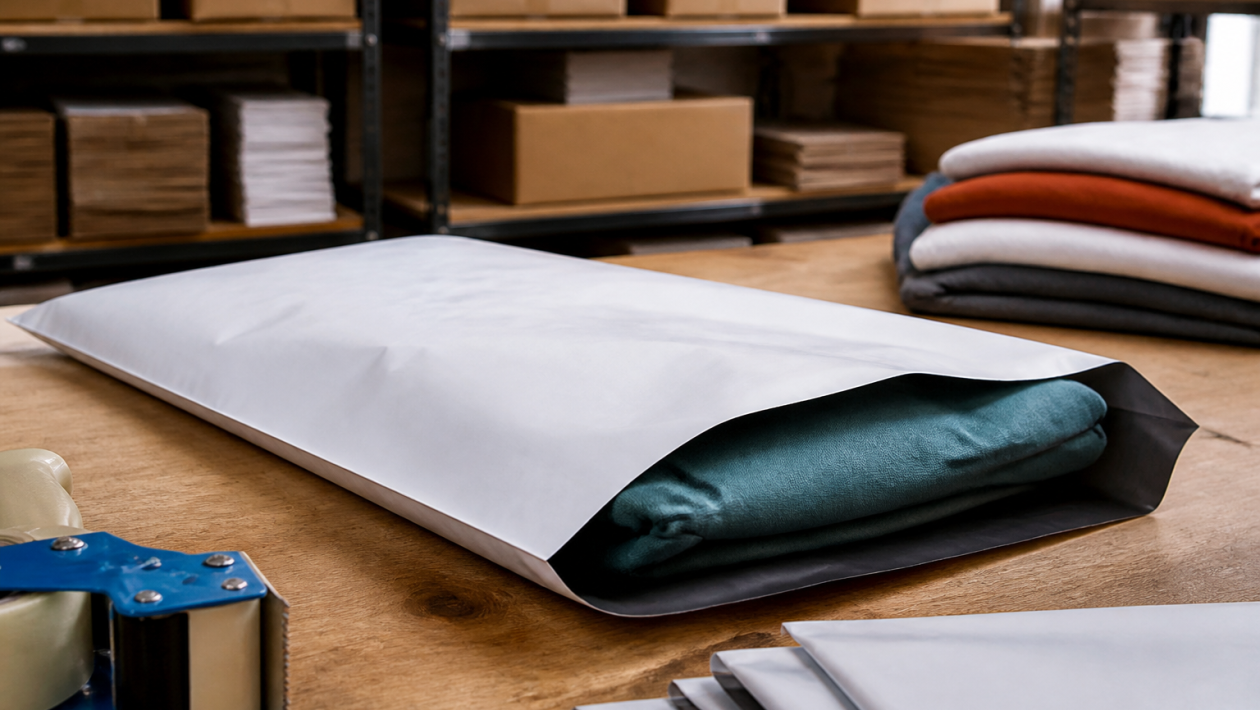
The 14×19 size handles hoodies, sweaters, and multi-shirt orders without stretching the seams. Step up to 19×24 for bundled apparel or a comforter-and-pillowcase set. The 24×24 — a near-square option — works well for bulkier flat goods like folded blankets or stacked linens where you need width in both directions, not just length.
Extra Large Poly Mailers for Bulky Apparel and Multi-Item Orders
Once orders run past three or four garments, extra large poly mailers (24×36 and beyond) start earning their keep. These handle multi-item bundles that would otherwise force a box upgrade — and a box upgrade almost always means a heavier dimensional weight charge on your next USPS or carrier invoice. Here’s the sizing test: if you can seal the mailer flat with an inch of slack, not three, you’ve got the right size. Too much extra material just adds bulk without adding protection.
Poly Mailers vs. Corrugated Mailers vs. Boxes for Apparel and Textiles
So which one actually saves you money on a folded sweater or a stack of t-shirts? Let’s break it down by weight class, because that’s really what this decision comes down to.
Poly mailers win for soft goods, plain and simple. A large poly mailer — think 14×19 or the bigger 24×24 — weighs almost nothing on its own, so you’re not paying to ship the packaging itself. They’re waterproof, tear-resistant, and they seal themselves. No tape, no extra labels needed beyond your shipping label.
Corrugated mailers sit in the middle. They fold flat, they’re rigid enough for something like a hoodie with a logo you don’t want creased, and they still weigh less than a box. Good option when a customer’s return policy demands a sturdier look.
Boxes? Skip them for clothing and textiles unless you’re bundling multiple heavy items. A box adds a pound or more of dead weight before your product even goes in — and at USPS and other carrier rates, that extra half-pound can bump you into a whole new pricing bracket.
Here’s the honest math: for a 2-pound clothing order, a poly mailer typically runs meaningfully cheaper to ship than the same order in a box. That gap adds up fast across hundreds of monthly shipments.
Where Sellers Actually Source Large Poly Mailers in Bulk
Here’s a number that surprises new sellers: buying large mailers one small pack at a time from a big-box store can run three to five times higher per unit than ordering a case online. A 10-pack of 14×19 poly mailers off a store shelf might average close to a dollar each once you account for the markup on convenience. Order 500 or 1,000 from a wholesale packaging supplier, and that per-unit cost often drops under $0.30 — sometimes lower depending on gauge and volume.
Buying Wholesale vs. Grabbing Small Packs from Staples or Walmart
Walking into a store for a quick pack makes sense exactly once — when you’re out of stock — an order needs to ship today. Beyond that, it’s an expensive habit. Retail shelf space is built for occasional buyers, not sellers moving 200+ orders a month.
Wholesale suppliers, by contrast, stock extra large poly mailers in bulk case sizes — 24×24, 24×36, even expansion styles — sized specifically for apparel, textiles, and flat goods. Buying this way means:
- Lower cost per mailer at volume
- Consistent thickness and seal quality across every order
- No repeat trips hunting for large poly mailers near you
- Custom branding options once volume justifies it
For anyone shipping apparel weekly, the math favors bulk ordering almost every time. Retail packs work for testing sizes. Wholesale works for actually running a business.
USPS Rules, Free Supplies, and What They Don’t Tell You About Poly Mailers
Here’s a myth that costs sellers real money: USPS does NOT hand out free poly mailers the way it does with Priority Mail flat rate boxes. Big difference. Priority Mail supplies — boxes, envelopes, some flat mailers — are free because you’re paying for a fixed-rate service. Regular poly mailers and large mailers you buy yourself, whether that’s a plastic bag rated for 10 lbs or an oversized 24×36 option, aren’t part of that program. Sellers who assume otherwise end up ordering the wrong packaging at the post office counter and paying for it — literally.
What USPS does give you is flexibility on rate class. A large mailer under 3/4 inch thick and under 13 ounces can often ship First-Class, which beats Priority Mail on cost for lightweight apparel. Go over 13 ounces and you’re bumped into Priority or Ground Advantage pricing — worth checking before you seal the bag.
A few things nobody puts on the label:
- Flat mailers over 3/4″ thick lose First-Class eligibility even if they’re technically “flat”
- USPS scales require the package to lie flat — stuffed, lumpy poly mailers get flagged for hand inspection, adding delay
- Certified mail and tracking add-ons apply the same to mailers as boxes — no discount there
Know the rate tiers before you buy in bulk. It saves headaches later.
Durability Factors: Mil Thickness, Tear Resistance, and Waterproofing
Reading Mil Thickness Labels Before You Buy in Bulk
A warehouse manager orders a pallet of large mailers for a denim line, checks the box in receiving, and finds the film feels thinner than the sample. That’s the moment mil thickness stops being a spec sheet number and starts being a real problem — because 1.75 mil poly won’t hold up the same way 2.5 mil does once it’s stuffed with folded jeans and tossed into a USPS bin.
Here’s the honest answer: for large shipping bags carrying apparel, aim for 2.5 mil minimum. Anything under 2 mil is fine for a light t-shirt — risky for multi-item orders or anything with zippers and buttons that can poke through from the inside.
- 2.5 mil — standard for large poly mailers moving clothing and mixed soft goods
- 3.5–4 mil — extra large poly mailers for bulky or heavier bundled orders
- Tear strip integrity — check that it runs the full width; a strip that stops short means customers cut into the bag itself
Waterproofing matters just as much as thickness. A mailer sitting on a wet loading dock for six hours needs a sealed seam, not just water-resistant film. Look for double-sealed side seams and a tamper-evident adhesive strip — that combination is what separates a mailer that survives transit from one that shows up with a soggy corner and an angry customer message waiting.
Matching Mailer Size to Product Type Without Wasting Postage
Bigger isn’t better. Grabbing an oversized poly mailer because it’s what’s on the shelf is one of the fastest ways to bleed money on every single shipment you send. Here’s the math nobody explains up front: carriers price by both weight and dimensions, so a mailer with three extra inches of slack costs you real money multiplied across hundreds of orders.
Start with the actual folded dimensions of your product, then add half an inch of buffer — no more. A folded t-shirt or two typically fits a 10×13, while a hoodie or bundled apparel order needs a 12×15.5 or the 14.5×19 size that’s become a default for clothing sellers moving multiple items at once.
- Single garment or accessories: 10×13 or 9×12
- Multi-item apparel orders: 12×15.5 or 14×19
- Bulky textiles, bedding, bundled clothing: 19×24 or larger extra large poly mailers
- Odd-shaped flat goods: expansion poly mailers with a gusseted bottom
Don’t guess. Measure your top five best-selling items, then order 24×24 or 24×36 sizes only for the outliers that genuinely need them. Most sellers stock two or three large mailer sizes max — that’s plenty for 90% of orders. Stocking every size “just in case” wastes storage and locks up cash that should be funding inventory instead.
Frequently Asked Questions
Does USPS give you free poly mailers?
No — and this trips people up constantly. USPS supplies free flat-rate boxes and envelopes for Priority Mail, but that’s it. Large poly mailers, bubble mailers, and shipping bags for clothes are something you buy yourself, whether from a packaging supplier, Staples, Walmart, or an online wholesale source.
How big is a large mailer?
In practice, “large” starts around 12×15.5 inches and runs up through 19×24, 24×24, and even 24×36 for bulkier apparel or multi-item orders. Anything past a standard #5 poly mailer size gets grouped into the large or extra-large mailer bags category. If you’re shipping bundled clothing, blankets, or multiple garments in one bag, you’re likely in 14×19 or bigger.
Is it cheaper to ship boxes or poly mailers?
Poly mailers win on cost almost every time for soft goods. A large poly mailer weighs a couple of ounces versus a pound or more for a comparable corrugated box — USPS First Class and Priority rates are driven heavily by weight and dimensions. Shipping clothing, textiles, or flat goods in plastic mailing bags instead of boxes can shave 20 to 40 percent off your average postage, depending on carrier and zone.
Where can I buy large mailing envelopes?
Online packaging suppliers carry the widest range of sizes — you’ll find far more depth than a local Staples or Walmart shelf, especially once you get into 19×24 or 24×36 territory. Buying wholesale by the case also drops your per-unit cost significantly compared to picking up a six-pack near me at a retail chain.
What’s the difference between a poly mailer and a bubble mailer?
A standard poly mailer is a flat plastic bag — lightweight, waterproof, and built for clothing, textiles, or anything that doesn’t need cushioning. A bubble mailer adds a padded lining for fragile or semi-fragile items. If you’re shipping shirts, jeans, or flat goods, skip the padding and save the extra weight and cost.
What mil thickness should I look for in large shipping bags for clothes?
2.5 mil is the standard for most apparel sellers — thick enough to resist tearing and punctures, thin enough to keep postage low. If you’re shipping bulkier bundles or using expansion poly mailers with a gusseted bottom, bump up to 3 mil or higher for extra durability during transit.
Can I get large poly mailers custom printed with my logo?
Yes, and it’s become standard practice for direct-to-consumer apparel brands. Most suppliers offer custom printing on large poly mailer bags starting at a few hundred units, letting you turn a plain shipping bag into a branded unboxing moment without switching to boxes.
Do large poly mailers work for USPS Certified or First Class Mail?
Large mailers ship fine through First Class Package Service and Priority Mail, but Certified Mail is really built for letters and documents in envelopes, not poly bags. If you need tracking and proof of delivery on a mailer, use Priority Mail or First Class Package with tracking instead of trying to force a Certified Mail label onto a mailer bag.
What size poly mailer should I use for a hoodie or bundle of clothing?
A single hoodie usually fits a 12×15.5 or 14.5×19 mailer. For bundles — two or three garments together — size up to 19×24 or an expansion mailer with a gusset, so you’re not stuffing the seams and risking a blowout in transit.
Are extra large poly mailers recyclable?
Most are made from #4 LDPE plastic, which is recyclable through store drop-off programs (the same bins that take grocery bags), though not typically through curbside recycling. If sustainability matters to your brand, look for mailers labeled with recycled content or ask your supplier about compostable alternatives before you commit to a bulk order.
Here’s the blunt truth: boxes still win for rigid or fragile products, but for soft goods — apparel, linens, textiles, flat accessories — they’re costing sellers real money every single day they keep shipping that way. Dimensional weight doesn’t care about your intentions. It cares about inches. And a folded shirt doesn’t need six sides of cardboard and a fistful of air around it.
Large mailers solve that math problem directly.
A 19×24 or 24×24 poly mailer holds the same bulky sweater or multi-item order a box would, minus the wasted cubic space carriers charge for. Pair the right size with the right mil thickness — 2.5 mil for everyday apparel, heavier for anything with edges or zippers — and damage claims stay low while postage stays lean.
Before the next reorder goes out, pull three of the heaviest-shipping SKUs from last month, measure them against current mailer stock, and check whether a size-up (or size-down) actually changes the postage bracket. That five-minute audit, done quarterly, will save more than any single supplier switch ever could.